Tuesday, 20 December 2011

Today I have had great fun printing, released my inner child.  I'm sure the company and enthusiasm of friend Catherine had a lot to do with the enjoyment, even though she was poorly with the flu.  Below are some     of the results, again they are based on stitches and some are based on the skin at the back of my hand.   

  
used masking tape to make stitches on acetate and put it through  the press.

small section of knitting put on roller and printed


Prints based on my skin pattern

Dry point etching on acetate


Dry point etching on monoprint


Monday, 12 December 2011


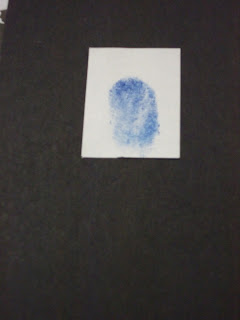
After knitting my jacket I thought I should write up the pattern for it.   However this proved more difficult than I thought it would be.  I couldn't bring myself to put my pattern into word form.   Cowardly or what, but gathering all the information to knit it opened a Pandora's box.   Emotions and issues I thought I had dealt with, even from childhood resurfaced again.    So off to the library and in a magazine I came across the work of Daniel Eatock.   I goggled him  and found out that as a graphic student one of his first projects was on identity.   He used his finger print, synonymous with identity and put text around the contour lines of his print.    This solved my problem, I decided to write up my jacket pattern in this form.    I played around with my finger print and blew it up on the copier, then I wrote my pattern around my contour lines quiet comfortably knowing that I would reduce it to finger print size again.    This meant that just like in the knitting of the garment all the information contained in the jacket and in the pattern is hidden, protected.  In this way, just as we do instinctively, only part of what I want to put on show as my identity will be seen.   Since then I have also flipped the text and left the finger print bigger.
Contextually as well as looking at the work of Daniel Eatock, I have been looking at Annette Messagner's and found some of what she said in an interview about her work very interesting and relevant to what I'm doing at the moment.

Taking the fingerprint


Blowing the finger print up on the copier in order to see the contour lines

                                                   
Writing text around the contour lines


Reducing the text back down to finger print size again          

Fabric finger print                                     


This fingerprint is sewn on to leatherette fabric using piping chord.    I based it on a sketch of my own finger print


This is a picture of the reverse side of the fabric, with chalk pastel added to show the contour lines, I like this version much better.


Friday, 25 November 2011


With reviews over and essays handed in, its time to get blogging.   My project has moved on again and as I said last time I've been looking at the single stitch.    I was fascinated by the way stitches are connected and how each one depends on  the next to form a piece of knitting, drop one and a hole appears, travelling right through the piece.   This lead me to to think about my connections and the stitches that link to form my pattern.   At this stage I was looking at the aran stitches and how when adapted they were linked to the identities of certain families. So how was I going show my pattern in a visual way.    I decided that because we all wear our identity constantly and because its invisible that I would knit a garment showing mine.   After careful consideration, I chose to knit this garment with official documentation relating to me.   The choice of material was very important.   It tells me who I am and where I've come from.    It also plots a pathway through my life.  The stitches at the back of the jacket symbolise parents,siblings, marriage and birth, and the dropped stitches represent death and loss.   The front panels relate to my marriage, children, education and health, all elements that form my identity. 
Keeping movement and motion in mind this garment shows how my identity has moved and changed over the years but also how it continues to evolve.

 Contextually, I've been looking at the work of Dave Cole, who produced a series of work called Trophy Wives and the Money Dress in 2006.   The dress, based on a Vera Wang design was knit with dollar bills.
Susie Mc Muarry is another artist who has produced a garment sculpture 'Widow' made out of unusual materials,  leather and 94 pounds of dressmakers pins.  'The prickly garment translates grief of lost love into a shorud that inflicts physical pain and repels human contact and sympathy.   Widow is the fourth in a series of garment sculptures that explore the concepts of female identity'.   It can be seen in the Victoria and Albert Museum's Power of Making.
Cutting strips of birth certs to form yarn to knit the jacket.
buttons for jacket,  old inhaler cases melted in oven and formed in to buttons.


                knitted jacket


  close up detail of jacket


wearing my identity


Dave Cole's 'Money dress'


Susie Mc Murray's garment sculpture 'Widow'


close up view of gown


Thursday, 3 November 2011


Decided to break my pattern down.   I'm looking at one component, the single stitch.   By doing this I hope to make the stitch much bigger but still move them and link them together.   I started by making them with wire, but I realized if they were solid, these structures wouldn't link together.


I then tried them in a salt dough form but the result was the same.   However I decided that these stitches had to move, so I photographed them and made a little movie with them.


 After looking at the structure of the stitch again I discovered that they needed to be arched to link.   I made a template in fimo, made a silicone mould and cast them in wax.   This was more successful and they move and link together very well.


Contextually as well as looking at artists who use knitting elements in their work, I have been looking at the work of Andy Goldsworthy.


Another material I looked at knitting with was  plastic tubing.  After knitting a small section 7m in length, I put some water with food colouring into the tubing, attached drinking straws to either end and the result is that the liquid with the air bubbles move around, reminding me of the traffic flow on the motorway.  So I'm back where I started.


Wednesday, 19 October 2011

Looking at bridge pattern in 3d.  After the seminar on 3d, I discovered there were many ways I could work in three dimension . The 1st structure I made was with rolled up newspaper, pva glue and tissue paper. I found that I was very drawn to the idea of using materials in a way that they were not necessarily designed for.   At this stage  I was looking at the work of Tim Hawkinson. He uses a huge variety of materials in many different ways, from human hair to cardboard, from spray foam to toothpaste tubes to finger nail clippings.


 Tim Hawkinson sculpture

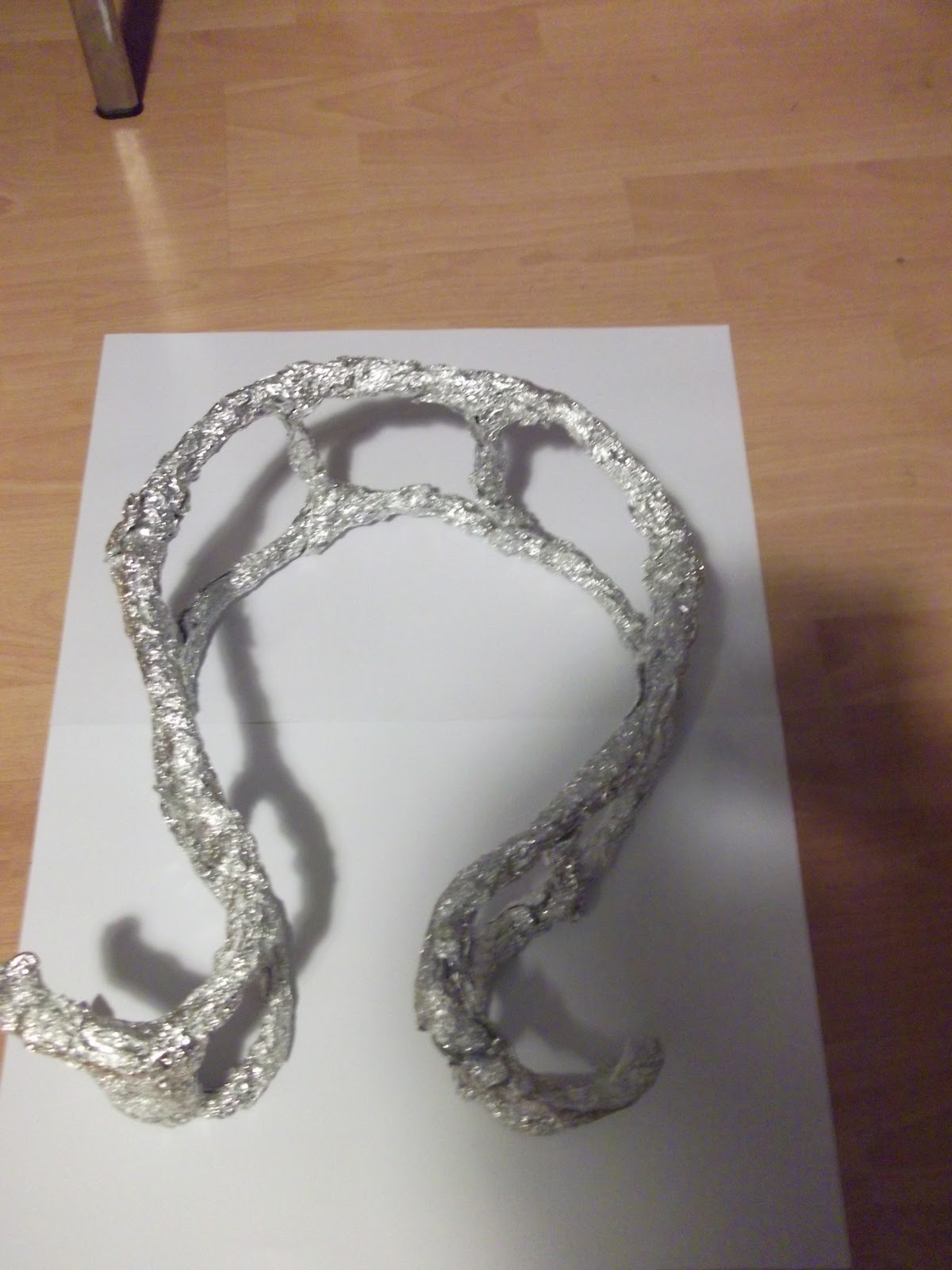
   As a result of seeing how he worked, I decided to use tin foil to interpret the pattern in the bridge structure of the motorway.     I wanted to make my pattern move, so I knit it and and hung it as a mobile. 

Other reasons for knitting  were that the intertwining stitches remind me of the way the roads  twist and turn and how they intersect with each other and the motorway.   Also I associate pattern with a knitting tradition, and it was something that I watched my Mother and Grandmother doing as a child.
 Even though the tin foil is stiff and solid, the act of knitting it loosened it and each of the sections twist and turn in their own right.
 
Wanting to explore this further,  I looked at other materials I could knit with, using wire and lagging for central heating pipes.   I was also looking at Artists who used knitting in their work.


 Susie Mac Murray is one Artist who used an knitting element in her work and this piece is knitted with human hair.

Friday, 14 October 2011


As I was looking at the road markings the arrows, the zig zag lines,broken lines and continuous lines, all these things reminded me of patterns and stitches. So I started to play with these lines. Keeping in mind that the project is 'movement'  how do I make these patterns move. I started to look at the Op Art period and how Bridget Riley's work says everything I wanted to say about implied movement.   Her work is so exciting it jumps off the page, makes you dizzy.  Your head knows this is 2d and its not moving, but yet your eyes tell you something different. Her work with squares, lines and circles all remind me of the road markings and the patterns I see on my journey every day.  To try to understand her work and how the eye sees movement, I'm reading Eye and brain.                                                                                                                                                                     
After looking at Bridget Riley's work I've returned to the photos I took on the motorway and I have taken a very simple pattern form one of the bridge rails.   So how do I make this pattern move.


After drawing various versions of the pattern I decided to make cut outs and scatter them randomly on a page to see what effect this had. I also used bigger cut outs and put them across the studio floor in order to see the effect of movement in this way.

     
Wanting to make this pattern more 3d I layered the cut outs in black and white to see what this would do to it.

   Also made small  paper models of the pattern and I used the white of the paper with two other colours to make the pattern more 3d.